
Understanding If-Then Rules in Crypto and DeFi Trading
In cryptocurrency and decentralized finance (DeFi) markets, price discovery occurs continuously across global exchanges and blockchain networks. These markets operate without traditional trading hours and are characterized by rapid fluctuations in liquidity and volatility. In this environment, structured decision-making is essential. One of the most practical tools for achieving consistency in trade execution is the use of if-then rules.
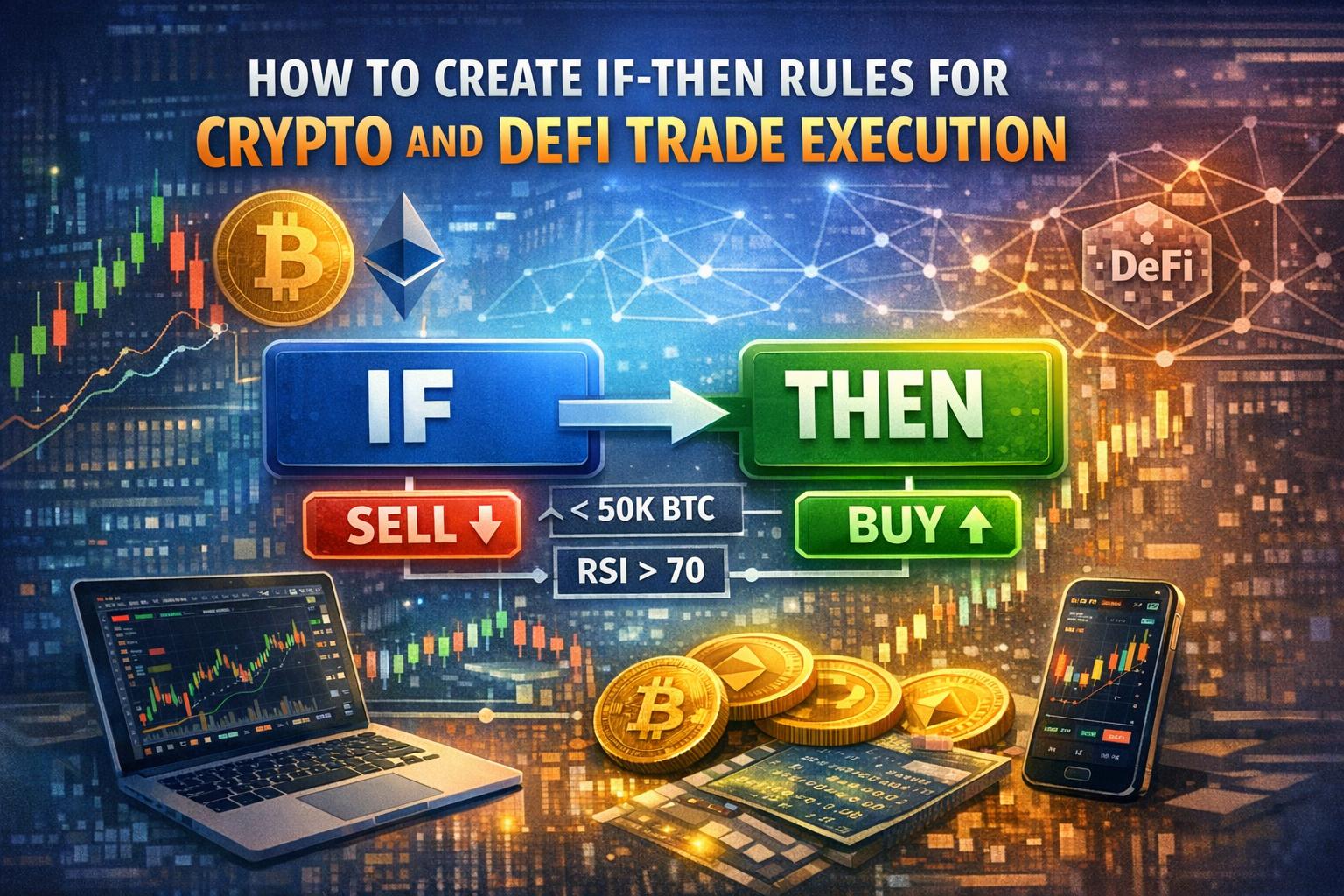
An if-then rule defines a logical relationship between a market condition and a resulting trading action. Instead of reacting manually to chart movements or news events, a trader predetermines specific conditions under which a trade will occur. When those conditions are met, the system executes the associated instruction. This process can be managed through centralized trading platforms, algorithmic trading software, or directly through smart contracts in DeFi protocols.
The application of structured logic to trading helps reduce inconsistency and supports disciplined execution. Rather than relying on interpretation at the moment of decision, the trader sets clear parameters in advance.
What Are If-Then Rules?
An if-then rule is a conditional statement. In its simplest form, it reads: If a certain condition occurs, then perform a defined action. Within crypto markets, the condition typically relates to measurable factors such as price levels, percentage movements, trading volume, market capitalization changes, or on-chain data.
For example, a rule might state: If Ethereum’s price rises above a specified resistance level, then place a buy order. Alternatively, it may state: If the value of a token drops by 5% within one hour, then execute a sell order.
The logic structure is deterministic. There is no interpretation once the system is configured. either the condition is met, or it is not. This clarity is particularly useful in crypto markets, where sudden volatility can pressure traders into rapid decisions.
In DeFi, if-then rules can also be embedded directly within smart contracts. For instance, a lending protocol may automatically liquidate collateral if the collateral ratio drops below a defined threshold. In this case, the “then” action is executed directly by the smart contract without human involvement.
Basic Components of If-Then Rules
Every effective if-then rule consists of three essential components: the condition, the action, and, in many cases, the time context.
Condition
The condition forms the “if” portion of the rule. It defines what must be true for the rule to activate. Conditions may be based on:
Price thresholds
Percentage changes
Technical indicators such as moving averages
Trading volume increases
On-chain metrics such as wallet activity
Funding rates or open interest in derivatives markets
The condition must be expressed in measurable terms. Ambiguous instructions such as “if the market looks bullish” cannot be automated. Instead, it must be structured as “if the 50-day moving average crosses above the 200-day moving average.”
Action
The action defines what happens when the condition becomes true. Most trading actions involve placing market orders, limit orders, or canceling existing positions. In DeFi, actions might include staking tokens, swapping assets, adjusting liquidity pool exposure, or closing leveraged positions.
The action must also be precise. It should specify position size, order type, and market venue where the execution will occur. Unclear actions can create unintended exposures.
Time Frame
Although some rules operate continuously, others apply only under certain time constraints. A trader may define that a rule is valid during specific market sessions or within a certain date range. Short-term strategies often incorporate candle durations, such as five-minute or hourly intervals, while longer-term strategies may rely on daily or weekly data.
Time conditions can also prevent repeated triggers. For example, a rule may state that it executes only once per day, even if the condition becomes true multiple times.
Implementing If-Then Rules
To implement if-then rules effectively, traders rely on automation tools. Many centralized exchanges provide conditional order types such as stop-limit or trigger orders. These built-in features represent basic forms of if-then logic.
More advanced traders may use algorithmic trading platforms or scripting environments. Platforms that support automated strategies allow users to define multiple layered conditions. For instance, a trade might activate only if both a price threshold and a volatility filter are satisfied.
In DeFi environments, automation may involve smart contracts. A user interacting with decentralized exchanges or yield protocols may rely on bots that monitor blockchain transactions and execute predefined instructions. In these cases, the logic can be deployed directly on-chain or managed through off-chain monitoring systems that initiate blockchain transactions when criteria are met.
Before deploying a live rule, traders typically conduct backtesting. Backtesting applies the rule to historical price data to evaluate how it would have performed in previous market conditions. While past performance does not guarantee future results, testing can highlight logical flaws, excessive trading frequency, or weak risk controls.
Paper trading or simulated trading is another method. In this setup, rules operate under real-time conditions without capital exposure. This allows adjustments before committing assets.
Applications in Spot and Derivatives Markets
If-then rules can be applied to both spot trading and derivative instruments such as futures and perpetual contracts.
In spot markets, rules commonly govern asset accumulation or distribution. A trader may define a systematic buying strategy, such as accumulating a fixed quantity if the price declines by a set percentage. Similarly, predefined sell rules may gradually reduce exposure as the market trends upward.
In derivatives trading, conditional logic often incorporates leverage and funding rate dynamics. For instance, a rule might trigger a hedging position if funding payments become significantly positive or negative. Another condition might automatically close a position if unrealized losses reach a certain threshold relative to account equity.
In both contexts, the goal is to encode risk management into execution rather than relying on manual monitoring.
Risk Management Through If-Then Logic
Risk management is one of the most important uses of conditional trading rules. Stop-loss and take-profit instructions are standard examples.
A stop-loss rule states: If the asset declines to a specified level, then close the position. This limits downside exposure. A take-profit rule states: If the asset reaches the target price, then lock in gains.
In crypto markets, where volatility can be high, risk rules may also incorporate trailing mechanisms. A trailing stop adjusts dynamically as price moves in a favorable direction. For example: If the asset declines by 3% from its highest recorded price since entry, then exit the trade.
More advanced risk controls may include portfolio-level conditions. Rather than monitoring individual assets only, a rule may activate if total portfolio drawdown surpasses a specified percentage. This approach helps protect overall capital.
In DeFi lending platforms, if-then logic is central to maintaining solvency. Smart contracts continuously evaluate collateral ratios and automatically liquidate positions when risk thresholds are breached. This prevents the accumulation of unbacked debt.
Advanced Strategies Using Conditional Rules
Conditional logic forms the backbone of algorithmic trading systems. Complex strategies may combine multiple rules to create layered decision trees. For example, a strategy might first determine the broader market trend using long-term moving averages, then apply short-term breakout rules only when aligned with that trend.
Arbitrage strategies depend heavily on automation. If price differences between two exchanges exceed transaction costs by a specified margin, then execute simultaneous buy and sell orders. Since arbitrage windows can close in seconds, manual execution is often impractical.
Market-making strategies also rely on conditional structures. If buy-side liquidity decreases below a threshold, then adjust bid quotes accordingly. If volatility increases sharply, then widen spreads to compensate for risk.
In DeFi liquidity provision, automated systems may rebalance token allocations if price divergence grows beyond certain boundaries. This ensures exposure remains within intended parameters.
Limitations of If-Then Rules
Although if-then rules offer consistency, they are not without constraints. Markets are influenced by unpredictable events, including regulatory announcements, exchange outages, and network congestion. A rigid rule may execute in conditions that differ substantially from historical patterns.
Slippage is another consideration. When a rule triggers a market order during periods of low liquidity, the execution price may deviate significantly from the intended level. Stop-loss rules, in particular, are vulnerable during rapid price gaps.
In DeFi ecosystems, blockchain congestion or high gas fees may delay transaction execution. A rule may technically trigger, but confirmation times could reduce effectiveness.
There is also the risk of over-optimization. When traders excessively fine-tune parameters to fit historical data, they may create strategies that perform well in backtests but poorly in live trading.
Ongoing supervision remains important. Automation should complement, not entirely replace, strategic oversight.
Operational Considerations
Successful implementation of if-then rules requires attention to infrastructure. Reliable internet connectivity, platform stability, and secure API management are fundamental. Traders using exchange APIs must manage authentication keys carefully to prevent unauthorized access.
Latency can influence execution quality. High-frequency strategies require low-latency connections to avoid delays between condition detection and action placement.
In decentralized systems, smart contract auditing is important. Errors in contract logic can expose users to irreversible losses. Reviewing contract code and understanding upgradeability mechanisms reduces operational risk.
Periodic evaluation of rule performance is also necessary. Markets evolve. A strategy built for high-volatility environments may underperform during consolidation phases. Reviewing statistical outcomes allows for data-driven adjustments.
Conclusion
If-then rules provide a structured framework for executing trades in cryptocurrency and DeFi markets. By defining objective conditions and predetermined actions, traders establish consistency and reduce reliance on discretionary judgments during volatile periods.
The logic behind these rules is straightforward, yet their applications range from basic stop-loss orders to complex algorithmic systems governing arbitrage, derivatives hedging, and liquidity management. When combined with thorough testing, robust infrastructure, and effective risk controls, conditional rules can enhance operational efficiency and strategic clarity.
However, automation does not eliminate uncertainty. Market structure, liquidity constraints, and technological limitations influence outcomes. Continuous monitoring and periodic refinements remain integral components of a disciplined trading approach.
Within the evolving landscape of digital assets, if-then logic remains a foundational element of systematic execution, bridging human strategy and automated decision-making systems.