
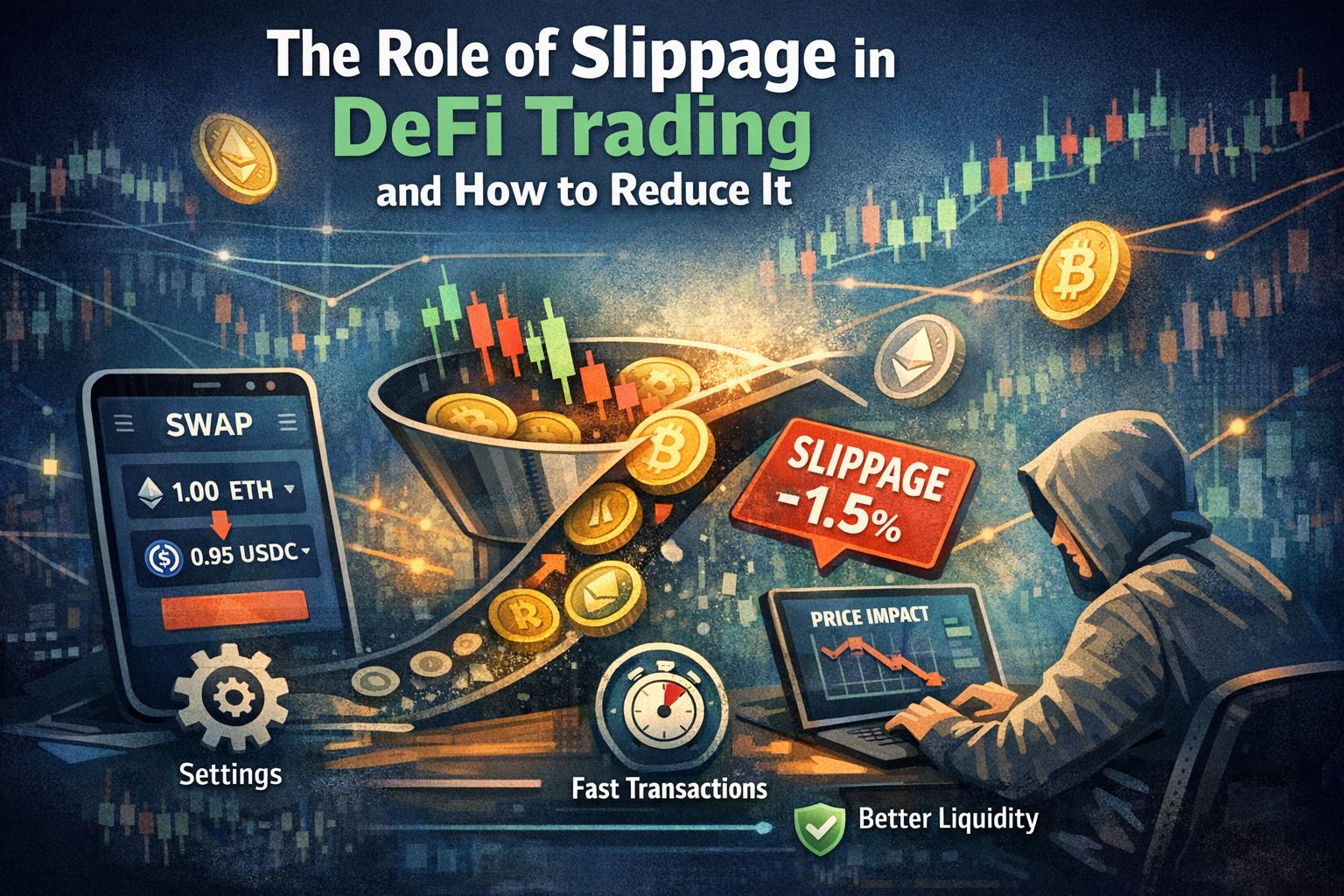
The Importance of Slippage in DeFi Trading
In the realm of Decentralized Finance (DeFi), slippage is a core concept that directly influences trade execution and overall transaction outcomes. Slippage refers to the difference between the price a trader expects when submitting a transaction and the price at which that transaction is ultimately executed on the blockchain. Although slippage exists in traditional financial markets, its characteristics in DeFi are distinct due to the structure of decentralized exchanges, liquidity pools, and blockchain settlement mechanisms.
Unlike centralized exchanges, where order books match buyers and sellers in real time, many DeFi platforms rely on automated protocols to determine asset pricing and execute trades. These mechanisms introduce unique dynamics that make understanding slippage essential for traders, liquidity providers, and protocol developers. Properly accounting for slippage is not merely a matter of reducing cost; it is a necessary component of managing risk and ensuring predictable interaction with decentralized trading systems.
Understanding Slippage in Decentralized Environments
Slippage occurs when a trader initiates a transaction at a quoted or observed price, but by the time the transaction is finalized on-chain, the price has shifted. This shift may result in a less favorable outcome than anticipated. In some cases, slippage can be positive, meaning the trader receives a better price than expected, but in most practical DeFi scenarios, discussions of slippage focus on the potential for adverse price movements.
In DeFi, transactions are not finalized instantly. When a user submits a trade, it is broadcast to the blockchain network and must be validated and included in a block. Depending on network conditions, this process can take seconds or longer. During that time window, market conditions may change. Because pricing in many DeFi exchanges is algorithmically determined by smart contracts and liquidity pool balances, even relatively small trades can alter the execution price.
Slippage in DeFi is closely tied to the structure of Automated Market Makers (AMMs). These systems do not rely on matching individual buyer and seller orders. Instead, they use mathematical formulas to price assets based on the ratio of tokens in liquidity pools. As traders interact with these pools, the balance shifts, resulting in price movement determined by predefined algorithms.
The Mechanics of Slippage in AMM-Based Exchanges
Most decentralized exchanges use a constant product formula, typically expressed as x × y = k, where x and y represent the quantities of two assets in a liquidity pool, and k remains constant. When a trader swaps one asset for another, the pool balance changes, thereby adjusting the relative price.
For small transactions in highly liquid pools, the price impact is limited. However, when a trade consumes a larger portion of available liquidity, the algorithm adjusts the price more significantly. This automatic price movement during the execution of the trade itself is a primary contributor to slippage in DeFi.
It is important to distinguish between price impact and slippage tolerance. Price impact refers to the change in price caused directly by executing a trade against a liquidity pool. Slippage tolerance, by contrast, is a user-defined parameter that sets the maximum acceptable deviation between the expected and actual execution price. If the execution price exceeds this tolerance, the transaction will revert and fail.
Market Volatility and Its Influence on Slippage
Market volatility plays a central role in slippage outcomes. Cryptocurrency markets, including DeFi tokens, often experience significant price swings within short timeframes. When traders submit transactions during periods of rapid price movement, the likelihood that the price will change before confirmation increases.
Volatility can be driven by macroeconomic announcements, protocol updates, large trades by institutional participants, or broader market sentiment. In decentralized systems, the speed of price updates can vary across platforms and liquidity sources. Arbitrage traders operate across multiple exchanges to align prices, but this alignment may not be instantaneous. As a result, a trader interacting with one protocol may experience slippage if external markets shift before confirmation.
Periods of elevated volatility also tend to coincide with higher blockchain usage, leading to network congestion. Increased congestion may extend transaction confirmation times, further heightening the probability of slippage.
Liquidity Depth and Market Efficiency
Liquidity refers to the capacity of a market to absorb trades without substantial price impact. In the context of DeFi, liquidity is supplied by users who deposit assets into pools. The depth of these pools determines how effectively large trades can be executed at stable prices.
In shallow liquidity pools, even modest trades can significantly shift the asset ratio. This direct relationship between trade size and pool size creates a measurable effect on slippage. For example, swapping a large quantity of tokens in a small-cap liquidity pool may cause a cascade of price adjustment within the algorithm, resulting in execution at a markedly different rate than initially quoted.
High-liquidity platforms, by contrast, distribute trade impact across larger asset reserves. This damping effect allows traders to execute sizable transactions with comparatively less slippage. Consequently, liquidity depth is a primary factor institutional participants evaluate before deploying significant capital in DeFi strategies.
Liquidity fragmentation across multiple platforms can also contribute to slippage. If liquidity for a trading pair is dispersed across many exchanges rather than concentrated, individual pools may lack sufficient depth to minimize price shifts. Aggregators attempt to address this by routing trades across multiple pools, thereby optimizing pricing and reducing aggregate slippage.
Transaction Processing Time and Network Conditions
Because DeFi transactions settle on blockchains, execution speed depends on network throughput and block confirmation intervals. Users must submit transactions with associated network fees, and validators prioritize transactions based on these fees and network rules.
During periods of congestion, transactions offering lower fees may experience delays. While pending in the mempool, these transactions remain exposed to ongoing price movement. By the time the transaction is included in a block, the pool composition may have changed due to other trades, resulting in slippage relative to the originally quoted output.
In some ecosystems, users can increase transaction fees to accelerate confirmation. However, even prioritization does not eliminate slippage risk entirely, as markets may continue moving during block production intervals.
Another factor unique to public blockchains is transaction visibility. Pending transactions may be observed by other participants before inclusion in a block. This transparency has led to phenomena such as maximal extractable value (MEV), where validators or sophisticated traders reorder or insert transactions to capture arbitrage or profit from predictable price movement. Such activity can alter execution conditions and contribute to additional slippage beyond standard market dynamics.
Slippage Tolerance Settings and User Controls
Most DeFi platforms allow traders to define slippage tolerance as a percentage threshold. This control determines how much deviation from the expected price the user is willing to accept. If the final execution price exceeds this tolerance, the transaction automatically reverts.
Setting slippage tolerance requires balancing certainty of execution against price protection. A very low tolerance reduces the risk of unfavorable pricing but increases the likelihood that the transaction will fail during volatile conditions. A high tolerance enhances execution probability but exposes the trader to greater variation in final price.
Advanced interfaces may dynamically suggest appropriate slippage ranges based on volatility metrics, liquidity conditions, and recent network activity. Nevertheless, the final responsibility remains with the user to determine acceptable trade-offs according to their strategy and risk parameters.
Limit Orders and Hybrid Trading Models
While many early AMMs supported only market-style swaps, newer DeFi protocols have introduced limit order functionality. A limit order specifies the maximum price a buyer is willing to pay or the minimum price a seller will accept. In decentralized systems, these orders may be implemented off-chain and executed through smart contracts when market conditions satisfy predefined criteria.
Limit orders help reduce slippage by removing uncertainty about execution price. However, they may also result in missed opportunities if prices move quickly and never reach the specified level. Hybrid models combining order book mechanics with automated liquidity pools attempt to integrate the advantages of both systems, reducing slippage while preserving decentralized execution.
The Role of Aggregators and Smart Routing
DeFi trading aggregators have emerged to mitigate slippage by scanning multiple liquidity sources and splitting orders across them. Instead of executing a large swap in a single pool, an aggregator may divide the trade across several platforms to achieve a more favorable blended rate.
Smart routing algorithms evaluate pool depth, transaction fees, gas costs, and expected price impact. By optimizing these variables, aggregators can significantly reduce effective slippage compared to executing the entire trade in a single, less liquid pool.
However, aggregator usage does not eliminate all slippage risks. Network congestion, MEV activity, and rapid price shifts can still affect outcomes, especially for time-sensitive or large transactions.
Large Transactions and Institutional Considerations
Institutional participants and high-volume traders face unique challenges related to slippage. For sizeable orders, even high-liquidity pools may not provide sufficient depth to prevent substantial price impact. Executing a large trade in a single transaction could move the market significantly.
To manage this issue, sophisticated traders may break large trades into smaller segments executed over time. This approach seeks to minimize immediate price disruption within liquidity pools. Some institutions also engage directly with liquidity providers or use over-the-counter mechanisms built on decentralized infrastructure to negotiate pricing outside public pools.
The transparent nature of blockchain transactions adds complexity for large participants. Market participants monitoring mempools can anticipate sizeable trades and act accordingly. This dynamic further underscores the importance of execution strategy and network fee optimization.
Risk Management and Slippage Awareness
Slippage is not inherently negative; it is a byproduct of open market interaction and algorithmic liquidity management. However, unanticipated slippage can materially affect trade profitability, arbitrage margins, yield farming strategies, and portfolio rebalancing.
Effective risk management in DeFi incorporates realistic slippage projections when estimating expected returns. Traders often simulate outcomes using current liquidity data before submitting transactions. Protocol analytics dashboards provide insights into pool depth, historical volatility, and average slippage metrics for various trade sizes.
Liquidity providers must also remain aware of slippage dynamics. The same mechanisms that enable traders to swap tokens can expose liquidity providers to impermanent loss when relative asset prices shift. Slippage, price impact, and arbitrage activity collectively shape pool performance and fee generation.
Future Developments and Evolving Infrastructure
The DeFi ecosystem continues to evolve, introducing new mechanisms intended to improve pricing efficiency and reduce slippage. Layer-two scaling solutions aim to reduce transaction latency and fees, thereby shortening confirmation windows and decreasing exposure to price movement during settlement.
Advanced AMM designs incorporate concentrated liquidity, allowing providers to allocate capital within specific price ranges. This approach increases effective liquidity where trading activity is most likely, potentially lowering slippage for common price intervals while maintaining capital efficiency.
Cross-chain interoperability solutions also seek to unify liquidity across networks, reducing fragmentation and improving market depth. As infrastructure matures, the structural causes of excessive slippage may gradually diminish, though they are unlikely to disappear entirely.
Conclusion
Slippage is an intrinsic element of DeFi trading, shaped by algorithmic pricing models, blockchain settlement mechanics, liquidity depth, and real-time market dynamics. It represents the difference between expected and realized execution prices, and its magnitude reflects the interaction between trade size, volatility, and network conditions.
Understanding slippage requires familiarity with AMM formulas, liquidity pool composition, transaction processing timelines, and user-configurable tolerance settings. Traders who actively evaluate these factors can better control execution risk and align outcomes with strategic objectives.
As decentralized markets continue to develop, tools for managing and mitigating slippage are likely to improve. Nonetheless, the decentralized and transparent nature of blockchain-based exchanges ensures that slippage will remain a fundamental concept in DeFi operations. A disciplined approach to liquidity selection, execution strategy, and network awareness remains essential for participants seeking consistent and predictable performance in decentralized financial markets.