
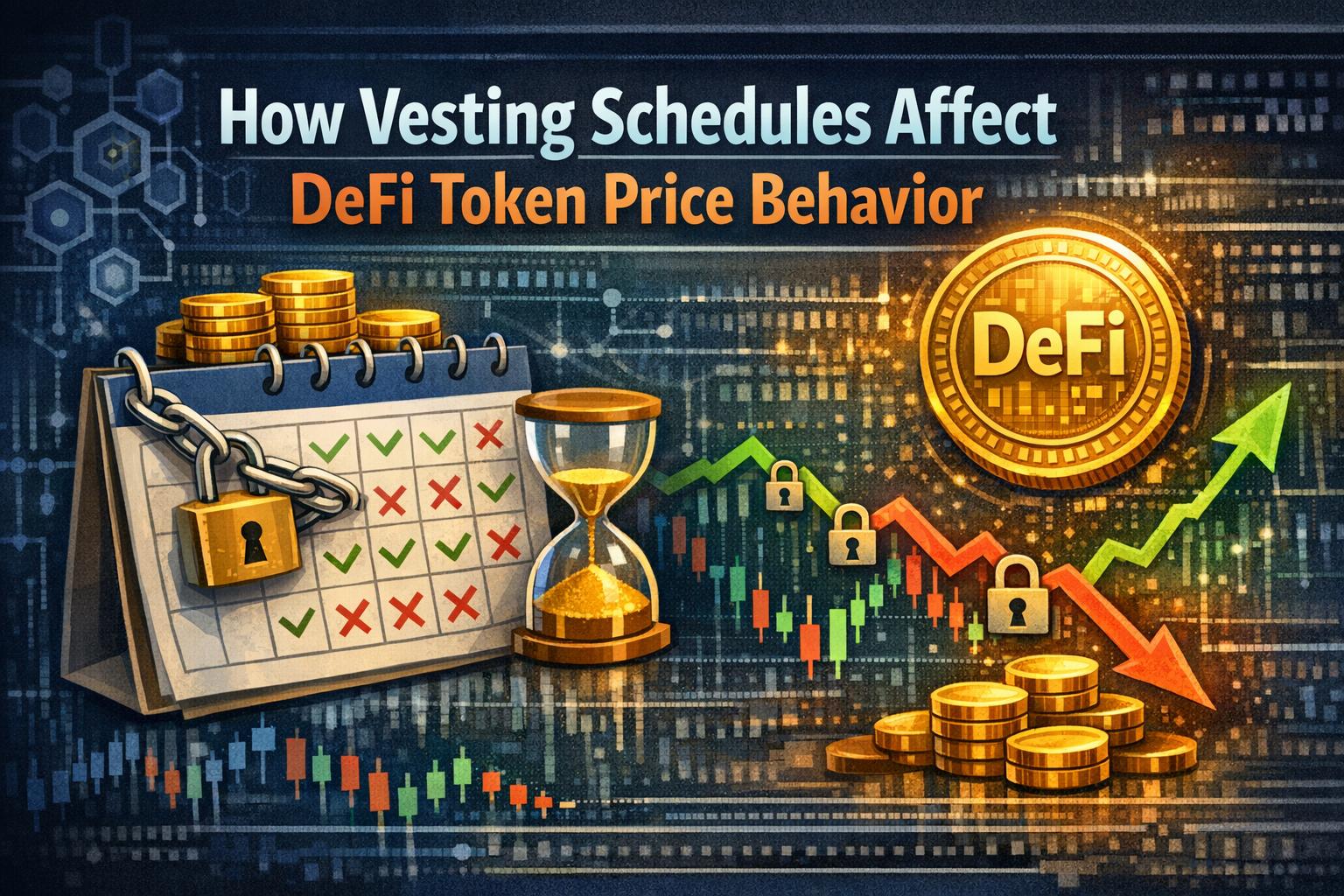
The Impact of Vesting Schedules on DeFi Token Prices
The decentralized finance ecosystem has introduced novel mechanisms for capital formation, governance, and value exchange. Among these mechanisms, vesting schedules have become a foundational component of tokenomics design. Although vesting originated in traditional equity compensation structures, its adaptation to token-based systems has introduced new dynamics that directly influence market liquidity, participant incentives, and price stability.
Token markets operate continuously and globally, often with high transparency due to blockchain data accessibility. In this environment, the programmed release of tokens into circulation through vesting schedules has measurable effects on supply-demand dynamics. Understanding these effects requires consideration not only of basic economics but also of behavioral responses, liquidity conditions, governance rights, and broader macro trends within digital asset markets.
Understanding Vesting Schedules
A vesting schedule establishes the rules that govern when allocated tokens become transferable or tradable. Typically, tokens are allocated to founders, team members, advisors, early investors, ecosystem funds, and sometimes community contributors. However, allocation alone does not guarantee immediate access. Vesting determines the timeline and conditions under which those tokens become liquid.
The fundamental purpose of vesting in DeFi projects is to align incentives. By restricting immediate access to allocated tokens, projects encourage long-term commitment from insiders and early backers. Without such mechanisms, recipients could sell their entire allocation shortly after listing, increasing circulating supply abruptly and potentially destabilizing the market.
From a design perspective, vesting contracts are often implemented using smart contracts that automate the release of tokens according to predefined rules. This programmability introduces transparency and predictability, as market participants can analyze blockchain data to anticipate upcoming unlock events. However, while predictability reduces uncertainty, it does not eliminate price volatility around vesting milestones.
Vesting schedules also contribute to the gradual transition from concentrated token ownership toward broader market distribution. In early project phases, token supply may be heavily allocated to insiders and investors. Through vesting releases and subsequent market trades, ownership becomes more dispersed over time. This distribution process influences governance participation and voting power in protocols that use token-based governance systems.
Types of Vesting Schedules
Vesting structures vary significantly across DeFi protocols, though several common models dominate the landscape. Cliff vesting involves a predetermined period during which no tokens are released. After the cliff period ends, a portion—or in some cases, all—of the allocated tokens become accessible. Cliffs are often set at six months, one year, or longer, depending on project strategy.
Following a cliff, projects frequently implement linear vesting, whereby tokens are released incrementally over a defined duration. For example, an allocation might vest evenly over 24 months after a 12-month cliff. This structure smooths token emissions into the market and reduces the risk of sudden supply shocks.
Some protocols adopt milestone-based vesting, in which releases are conditional upon achieving predefined technical or adoption benchmarks. Although less common in purely decentralized projects due to automation complexity, milestone models are designed to directly align token access with performance outcomes.
Another variation includes graded vesting schedules that accelerate or decelerate releases depending on governance decisions or ecosystem growth metrics. In certain cases, governance tokens held by core contributors may vest over extended periods exceeding four or five years, reinforcing long-term alignment while signaling commitment to the market.
A hybrid approach combining cliffs, linear distributions, and ecosystem-triggered releases is increasingly prevalent. These composite structures attempt to manage liquidity, incentivize commitment, and accommodate strategic funding needs simultaneously.
Token Supply Mechanics and Circulating Supply
To understand the impact of vesting schedules on price behavior, it is essential to distinguish between total supply and circulating supply. Total supply represents the maximum or defined number of tokens created. Circulating supply reflects tokens that are unlocked and tradable in the market.
Vesting events directly influence circulating supply. When tokens unlock, they transition from restricted status to transferable assets. Even if holders choose not to sell immediately, the increased potential liquidity can alter market expectations.
In DeFi markets, price levels are determined at the margin. A relatively small imbalance between buy and sell orders can produce measurable price changes. When a significant unlock event occurs, the possibility of new sell-side participation may influence order book depth and short-term pricing, even before actual transactions take place.
Moreover, liquidity conditions vary across exchanges and decentralized liquidity pools. Tokens with limited market depth are particularly sensitive to unlock-related supply changes. In contrast, highly liquid tokens with substantial trading volumes may absorb new supply more efficiently.
Vesting and Token Price Dynamics
The timing and scale of vesting releases can generate predictable cycles in token price behavior. In many cases, markets attempt to price in expected unlock events ahead of their occurrence. If participants anticipate that newly vested holders will sell, the price may decline gradually in advance of the unlock date.
Conversely, if the project demonstrates strong growth metrics or increasing protocol revenue, market confidence may offset potential selling pressure. In such situations, unlock events may have limited observable impact, especially if overall demand remains robust.
The magnitude of token allocation subject to vesting also influences outcomes. For instance, if a project allocates 20 percent of total supply to early investors with a three-year vesting schedule, each monthly release may represent a modest fraction of circulating supply. However, if a large cliff release suddenly unlocks a substantial percentage relative to current liquidity, short-term price pressure is more likely.
Market structure plays an additional role. In decentralized exchanges using automated market maker models, price slippage increases with larger trades relative to pool size. Therefore, if vested token holders distribute tokens into shallow liquidity pools, price fluctuations may be more pronounced.
Advanced market participants often monitor publicly available token unlock calendars and blockchain data analytics to estimate upcoming supply shifts. This level of transparency is unique compared to many traditional financial markets, where insider share lockups may be less directly observable.
Market Perceptions
Perception frequently amplifies the tangible effects of vesting. Transparent communication about vesting frameworks signals organizational discipline and long-term planning. When projects clearly disclose token allocations, release schedules, and smart contract addresses governing vesting, they foster credibility.
Uncertainty, by contrast, can increase volatility. If vesting terms are modified without broad consensus or clear explanation, market participants may question governance integrity or fairness. This can indirectly influence price through reduced participation or trust.
Concerns about price manipulation may arise if insiders are perceived to coordinate sales around unlock events. Even absent evidence of misconduct, the perception of informational asymmetry can affect sentiment. Projects that lock team allocations for extended periods often aim to mitigate such concerns.
In addition, vesting schedules can influence how institutional investors evaluate risk. Structured, long-duration vesting periods may indicate stability and decrease the probability of abrupt liquidity shocks. Short or loosely defined vesting, in contrast, may be interpreted as increasing near-term downside risk.
Secondary Effects on Governance and Participation
Beyond direct price implications, vesting schedules affect governance structures in token-based protocols. Governance power is commonly proportional to token holdings. When tokens remain locked, voting rights may be restricted or delegated differently depending on smart contract rules.
If a large governance allocation vests over time, the distribution of voting influence gradually shifts. This can alter proposal outcomes and influence long-term protocol strategy. Consequently, market participants may factor expected governance shifts into valuation assessments.
Vesting can also encourage continued contribution from core team members. Developers and founders with gradually unlocking tokens retain a financial incentive to expand ecosystem utility, increase adoption, and maintain technical infrastructure. Sustained project development contributes indirectly to token valuation through user growth and revenue expansion.
Community-focused vesting allocations, such as grants or incentive funds, influence ecosystem participation patterns. For example, tokens reserved for liquidity mining or yield incentives often follow emission schedules that resemble vesting models. These emissions can temporarily increase circulating supply while stimulating user activity. The interplay between incentivized demand and increased supply contributes to complex price dynamics.
Liquidity Planning and Treasury Management
Project developers must account for vesting schedules when planning treasury operations. If a protocol relies on periodic token sales to fund operational expenses, the release schedule may overlap with market conditions in ways that amplify volatility.
Strategic treasury diversification can mitigate reliance on token price appreciation alone. Some projects convert a portion of vested tokens into stable assets gradually to reduce exposure to price swings. Transparent reporting of such treasury actions can moderate speculation surrounding unlock events.
Staggered vesting across multiple stakeholder groups helps distribute potential liquidity impacts over time. Rather than releasing large allocations simultaneously, projects may sequence team, advisor, and investor vesting dates to reduce concentrated supply increases.
Strategies for Investors
Investors analyzing DeFi tokens often incorporate vesting schedules into valuation models. A key metric is the ratio between circulating supply and fully diluted supply, which represents total tokens that will eventually exist. A substantial gap between these metrics indicates considerable future unlocks.
By studying vesting calendars, investors can estimate emission rates and calculate potential supply growth over defined periods. This enables scenario analysis under different demand assumptions. For shorter-term traders, unlock dates may represent periods of heightened volatility that warrant adjusted position sizing or hedging.
Long-term investors may focus less on individual unlock events and more on whether vesting aligns with sustainable ecosystem growth. If token releases coincide with expanding user adoption or increased protocol revenue, supply growth may be absorbed more naturally.
Due diligence also involves evaluating who receives vested tokens. Allocations to strategic partners may produce different market effects than allocations to venture investors with predefined return horizons. Similarly, core team vesting may present lower immediate sell risk if participants are deeply involved in development activities.
Comparisons with Traditional Financial Markets
Although vesting in DeFi shares conceptual similarities with equity lockup periods in initial public offerings, differences in market structure produce distinct outcomes. Crypto markets operate continuously, lack centralized disclosure regimes in many jurisdictions, and often exhibit higher volatility.
In traditional equity markets, lockup expirations can influence share prices, but trading activity typically occurs within more regulated and liquid environments. In DeFi markets, token liquidity may vary widely, and participants have immediate access to blockchain data revealing precise unlock quantities.
Furthermore, DeFi tokens frequently serve dual purposes as both governance instruments and speculative assets. This hybrid function amplifies the impact of vesting because supply changes may affect both economic value and decision-making authority simultaneously.
Project Developers and Vesting
For development teams, constructing an appropriate vesting framework involves balancing multiple factors: capital efficiency, incentive alignment, liquidity stability, and community trust. Excessively short vesting may create rapid turnover among stakeholders, while excessively long vesting may discourage participation from early contributors seeking predictable returns.
Clear documentation of vesting parameters in technical documentation reflects accountable governance practices. Smart contract audits and transparent allocation disclosures reinforce credibility. Projects that integrate vesting logic directly into immutable smart contracts reduce counterpart risks and discretionary alterations.
Adaptive governance structures may allow token holders to revise certain vesting parameters in exceptional circumstances. However, such flexibility must be carefully designed to avoid undermining predictability. Stability in issuance policy contributes to long-term confidence in the protocol.
Long-Term Market Implications
Over multi-year horizons, vesting schedules gradually transition tokens from concentrated allocations into open circulation. As the vesting cycle concludes, tokens approach their fully diluted supply state. Price discovery then becomes driven more by organic demand factors rather than emission-driven supply increases.
Projects with disciplined vesting structures may experience fewer abrupt liquidity disruptions and more stable participation trends. Conversely, poorly structured or opaque vesting can contribute to recurring volatility spikes and erosion of participant trust.
In maturing DeFi markets, increased analytical tooling and standardized disclosure practices have improved visibility around token release dynamics. As investor sophistication grows, vesting schedules are increasingly evaluated as integral components of valuation rather than peripheral technical details.
Conclusion
Within the DeFi ecosystem, vesting schedules exert substantial influence over token price behavior, liquidity conditions, and governance distribution. By regulating the timing and scale of token releases, vesting shapes circulating supply trajectories and affects both actual and anticipated market dynamics.
Transparent, well-structured vesting frameworks contribute to incentive alignment and signal long-term commitment from project stakeholders. Investors who examine vesting calendars, allocation structures, and emission rates gain clearer insight into potential price pressures and volatility patterns.
As decentralized finance continues to evolve, vesting design remains a central element of responsible tokenomics. For comprehensive analysis of any specific protocol, stakeholders should review relevant project documentation and, when necessary, consult project teams directly to understand the precise mechanics governing token distribution and release.