
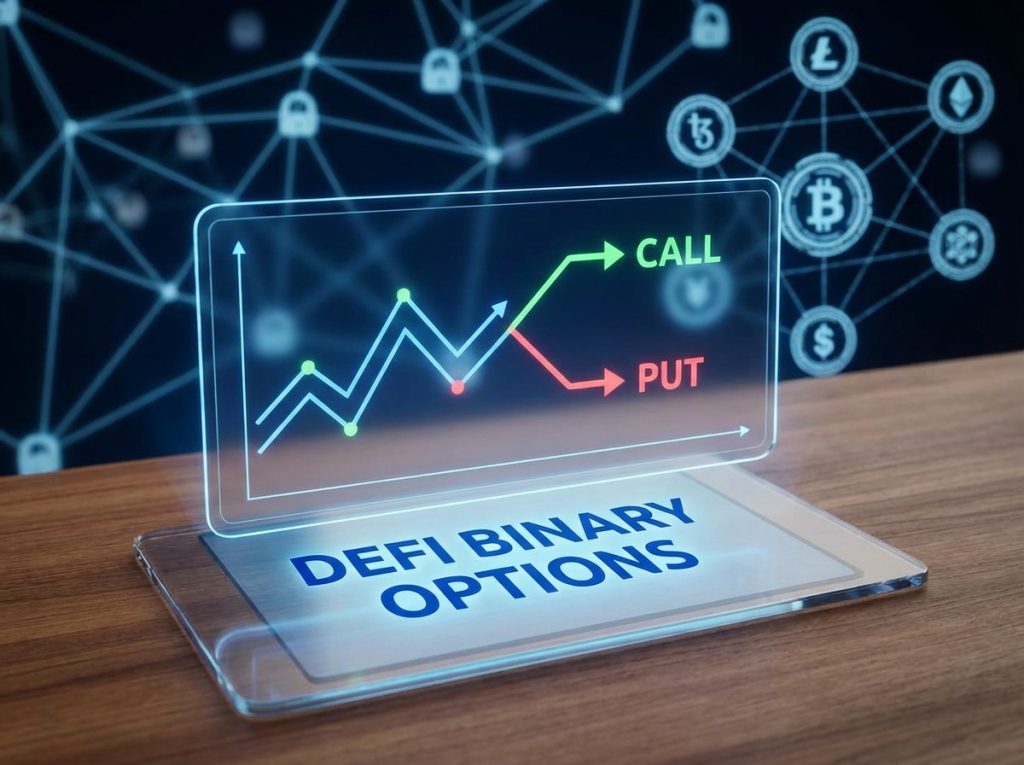
Binary options in the traditional sense are very simple bets: will the price or some variable be above a threshold at a fixed expiry? In DeFi you see the same payoff shape implemented in two broad ways, as on-chain binary-style derivatives built with options primitives, and as prediction-market contracts that pay out on a yes/no event, but the technology and the risks are materially different from what a retail trader expects on a regulated exchange.
DeFi swaps out middlemen for smart contracts, oracles, and some clever code,so you get more transparency and automation, but also a whole new set of things that can break. Think: buggy contracts, oracles feeding bad prices, traders jumping ahead of your orders (front-running), shaky bridges, and even scammy lookalike apps. Add in the fact that most places still haven’t figured out how to regulate this space, so crooks have plenty of room to play.
Here, I’ll break down the main DeFi setups you’ll run into, highlight the tech and legal risks you actually need to care about, show how recovery scams get mixed in, and lay out some practical rules for folks who want to dig deeper, instead of just aping into the latest “opportunity” on social media.
This article will focus on DeFi binary options. If you want to learn more about binary options in general and how binary options trading works, where it’s legal, and so on, then I recommend you visit BinaryOptions.net. Binaryoptions.net is one of the biggest binary option websites on the net it’s known to provide honest, non-promotional information.
Two technical families: prediction markets and options-style binaries
On-chain “binary” payoffs are normally implemented in one of two styles. One is a prediction market: users buy position tokens that resolve to 1 (pays 1 stablecoin) or 0 depending on an external event; Polymarket and Augur are high-profile examples of this category and they function more like event betting markets than exchange-listed derivatives. The other is an on-chain options or derivatives protocol that offers binary-like contracts (a fixed payout if a spot price breaches a strike at expiry) or dedicated binary product rails; some DeFi projects explicitly market binary-style products while the broader DeFi options ecosystem (Hegic, Opyn, Lyra and others) supports a variety of payoff shapes. Architecturally the prediction market model depends on an oracle and a resolution mechanism for the event outcome, while the options model depends on a pricing and settlement mechanism that may use pooled liquidity or AMM-style quoting. Both are feasible on-chain, but both depend on external data and on well-written contracts to avoid catastrophic failure.
Where DeFi binary offers diverge from regulated binary options (and why regulators banned retail binaries)
Regulators in many jurisdictions concluded that short-dated binary products are highly prone to consumer harm and fraud; the UK’s FCA made the retail ban permanent in 2019 for those reasons. DeFi implementations remove the single regulated counterparty but do not remove the core harms: the fast payoff profile incentivises excessive betting, operators or front-ends can manipulate user flows, and offshore or anonymous deployments evade local consumer protections. In practice a DeFi “binary” can look like a prediction market or like a securitised binary option — the economic effect for a user is similar: short, gambling-like payoff with high house edge risk. The regulatory background is important because where local law bans or restricts retail binary offers, a DeFi front-end that presents a binary payoff to a retail user may still be unlawful or at least expose the user and any hosting parties to enforcement and to limited legal recourse.
The concrete technical hazards you must model before touching a contract
A DeFi binary product looks simple until you unpack the plumbing. Three technical hazards dominate losses in practice.
First, oracle failure and manipulation. If the contract relies on a price feed or an off-chain event oracle to decide winners and losers, a manipulated or delayed oracle can change payouts instantly; historical DeFi incidents show flash loan exploits and oracle manipulation cause outsized losses. Protocols mitigate this with decentralised oracle sets and data aggregation, but “decentralised” can be thin in practice and not immune to rapid, coordinated manipulation.
Second, MEV and transaction ordering. On public chains your transaction enters a mempool and is visible to bots and searchers that can re-order or sandwich your trade. For a binary bet that depends on a price at a block or time, adversaries can extract value by inserting transactions that move the on-chain reference price just before settlement or by paying to prioritise blocks. Aggregators and private relays reduce exposure, but protection varies by protocol and chain. MEV is an execution risk that directly converts a seeming win into a loss if settlement windows are narrow.
Third, smart contract bugs and composability exploits. A single vulnerable function or an unexpected interaction with another protocol (a bridge, a router or an AMM) can open the contract to drains. Audit reports help but are not guarantees; attackers repeatedly find novel attack vectors or combine flash loans with oracle quirks to drain pools. Because DeFi binaries are often thinly capitalised they can be drained quickly and settlement logic can leave honest users with no remedy.
Economic and liquidity risks specific to binary payoffs
Binary contracts create concentrated settlement events: many positions resolve at the same moment and the contract must have liquidity available to pay winners. Low TVL, thin liquidity or capital providers with withdrawal rights can all break settlement in a stressful outcome. In pooled peer-to-pool models the pool’s economics (premiums collected vs claims paid) determine solvency; in prediction markets thin books create large price swings and extreme slippage. If you trade a large ticket relative to pool depth your executed price and the ultimate payout can be far worse than the quoted market probability. Protocols that advertise “high payouts” often have high implicit vig or require you to accept wide spreads to get in.
Front-end and social engineering dangers — the human layer of DeFi scams
A great deal of loss in DeFi binary offers comes not from protocol code but from UX and social engineering. Rogue front-ends that clone a legitimate UI but route approvals to a malicious contract are routine. Telegram, Discord and DMs are the common recruitment channels for aggressive promoters. Victims then sign approvals that give an attacker permission to sweep tokens and to impersonate the legitimate protocol. The same pattern recurs in recovery scams: once victimised, people receive recovery offers that demand upfront fees or credential transfer. The right operational defence is simple: never sign blanket approvals, verify contract addresses on the project’s official channels, and assume unsolicited “help” is probably a second-stage scam. The official public warnings on recovery frauds apply equally to DeFi losses: do not pay a supposed recovery firm without independent verification.
How DeFi binary-style products map onto prediction markets and why that matters
Prediction markets (Polymarket, Augur, Thales-style systems) are economically similar to binary options because they price a probability and pay out on an event resolution. The important differences are institutional: prediction markets often emphasise event markets (politics, sports) and use oracles for resolution; binary options historically referenced financial asset prices. From a risk perspective prediction markets remove some kinds of price-manipulation risk (if the event is externally verifiable) but they still depend on reliable resolution oracles and governance processes that can be gamed. Some DeFi projects explicitly position themselves between prediction markets and financial binaries, which creates regulatory ambiguity and is used by bad actors to claim decentralised “legitimacy” while sidestepping local rules. Treat any protocol that calls a binary payoff a “prediction market” with scepticism until you verify the contract, the oracle, and the governance model.
Regulatory and legal context — what to check for your jurisdiction
If you are in a country that bans or restricts retail binary options (the UK is an example), a DeFi-hosted binary may still be subject to enforcement. The absence of a central operator does not necessarily shield the front-ends, promoters or connected custodial entities from local law. Even where DeFi itself sits in a gray area, on-ramps (fiat rails) and custodial bridges generally require regulated partners who will enforce KYC/AML and can be compelled to act.
Recovery scams in the DeFi world — the same playbook with crypto plumbing
The fund-recovery scam described by consumer protection agencies follows the same script in crypto: a victim of a DeFi loss is contacted by someone offering to recover funds in exchange for upfront fees or access. In crypto this often includes requests to transfer crypto to an “escrow” wallet, sign messages, or temporarily reveal keys — all red flags. Because crypto transfers are often irreversible, criminals use the promise of traceability to extract more money. Official guidance from financial authorities is identical: preserve evidence, stop communicating with recovery callers, and notify your exchange or bank immediately. Do not hand over credentials or pay “recovery” fees without independent verification from regulated legal advisers.
Practical vetting checklist before you ever touch a DeFi binary product
If you’ve read the warnings and still want to dive in, get methodical with your checks. Start by double-checking the exact contract addresses and actually looking at the on-chain code. Read every audit—note when they were done and what they covered (old audits miss new bugs). Make sure the price oracle setup isn’t just someone flipping a switch in the background, and that it’s decentralized enough for your needs.
Check the total value locked (TVL) and see if the spreads are wide enough to handle the size you plan to trade. Find out exactly how the app sends your transactions—are you going through the public mempool or a private relayer? Does the UI clearly show what’s actually happening when you click “submit”? Look at the withdrawal process and watch for any timelocks that could freeze your funds.
Search for any regulatory warnings or community reports about hacks or issues. Do a small test trade, then try to withdraw. If anything feels murky or you hit a wall, stop right there. In DeFi, sloppy habits don’t just sting—they can wipe you out. Good habits keep you in the game.